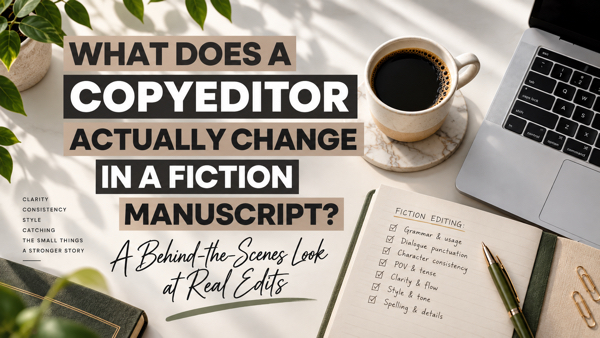
What Does a Copyeditor Actually Change in a Fiction Manuscript?
Authors ask us some version of this question constantly: okay, but what are you actually going to do to my book? It’s a fair question. “Copyediting” is a vague word until you see it applied to an actual page. So here’s the concrete version, with real examples of the kinds of catches a copyeditor makes in a novel manuscript.
Accidental POV shifts
A scene locked in one character’s point of view suddenly reveals something that character can’t know.
Before: Maya frowned at the note, unaware that across town, her brother was already regretting what he’d written.
Copyedit: Maya frowned at the note, wondering what her brother had meant by it.
Why: The original sentence steps outside Maya’s knowledge to narrate what’s happening to her brother elsewhere. If the book is written in close third person, the narration can’t know more than Maya does in the moment.
Timeline and continuity problems
Before: It had been three days since the funeral. [Two pages later] A week had passed, and Maya still hadn’t returned his calls.
Copyedit: Flagged for author query: does the timeline jump from three days to a week within this scene, or should the second reference be adjusted?
Why: Copyeditors track timelines, ages, seasons, and travel distances across the whole manuscript. When the math doesn’t hold up, it gets flagged, not silently rewritten, since only the author knows the intended timeline.
Dialogue punctuation
Before: “I told you not to touch it.” She said, crossing her arms.
Copyedit: “I told you not to touch it,” she said, crossing her arms.
Why: A dialogue tag like “she said” is part of the same sentence as the quote, not a new one, so it takes a comma and a lowercase letter, not a period and a capital.
Repetitive words and phrases
Before: She shrugged and walked to the window. She shrugged again and pulled the curtain closed. Later, she shrugged at his question and said nothing.
Copyedit: She walked to the window and pulled the curtain closed without a word. Later, she only shrugged at his question.
Why: One repeated gesture reads as a habit. Three in close proximity reads as a word the writer reached for out of habit. A copyeditor tracks these patterns across chapters, not just within a page.
Unnecessary dialogue tags
Before: “You’re late,” she said angrily. “I don’t care,” he replied dismissively.
Copyedit: “You’re late.” “I don’t care.” He didn’t even look up.
Why: When the dialogue and action already carry the emotion, the adverb-heavy tag is telling the reader something the scene has already shown. Trimming it tightens the exchange instead of padding it.
Awkward or unclear sentences
Before: Having been left alone for the first time since the accident happened, the silence of the house that she had grown up in was something Maya wasn’t prepared for.
Copyedit: Alone in the house for the first time since the accident, Maya wasn’t prepared for the silence.
Why: The original buries the subject of the sentence, Maya, under two stacked clauses. Moving her to the front of the sentence makes it clear who the sentence is about and easier to read at speed.
Tense shifts
Before: Maya walked into the kitchen and pours herself a glass of water.
Copyedit: Maya walked into the kitchen and poured herself a glass of water.
Why: A manuscript written in past tense that drifts into present tense mid-sentence, usually during fast-drafted action, is one of the most common catches in a first copyedit pass.
Character-detail inconsistencies
Before: “As a grown man, I don’t understand why y’all always leave the toilet seat up,” Denise said.
Copyedit: Flagged for author query: Denise is established as a woman earlier in the manuscript. Did you mean “as a grown woman,” or is this line intentionally referencing someone else?
Why: A copyeditor tracks names, ages, eye color, relationships, and small biographical details as they accumulate across the manuscript. A line like this one gets flagged rather than silently changed, because the fix depends on what the author actually intended.
Capitalization, hyphenation, spelling, and style consistency
Before: Mom told me to call Grandma. Later: My mother said Grandma was on her way. [Elsewhere:] anti-hero, antihero, mother-in-law, mother in law
Copyedit: A style sheet is built for the manuscript, and every instance is made consistent according to it: Mom or mother, capitalized or not, based on whether it’s used as a name or a common noun; one spelling of antihero; one treatment of mother-in-law throughout.
Why: Readers register inconsistency even when they can’t name it. A style sheet is one of the deliverables you get back with a copyedit, and it’s what keeps a 90,000-word manuscript internally consistent instead of just consistent page to page.
Factual or internal inconsistencies
Before: Maya’s eyes are described as brown in chapter two and green in chapter fourteen. A character says it’s Tuesday in one scene and references “last Friday” two scenes later in a way that doesn’t add up.
Copyedit: Both flagged for author confirmation, with the earlier reference noted for comparison.
Why: These are the details an author, deep in their own manuscript, is the least likely to catch. A second set of eyes tracking the whole book at once is what surfaces them.
Overused filler words
Before: She just really needed to actually tell him the truth, but she just couldn’t quite find the words.
Copyedit: She needed to tell him the truth, but she couldn’t find the words.
Why: Just, really, actually, quite: these words often do more to hedge a sentence than strengthen it. Cutting them tightens the prose without changing what’s being said.
Formatting inconsistencies
Before: Scene breaks marked with *** in some chapters, a centered # in others, and a blank line with no marker elsewhere. Some chapter titles in title case, others in all caps.
Copyedit: One scene-break style and one chapter-heading format applied consistently throughout.
Why: This is easy to overlook while drafting across months, but it reads as unpolished to anyone evaluating the manuscript, an agent, a formatter, or a reader.
What all of this adds up to
Good copyediting should make your writing better without making it sound like the editor wrote it. Every example above is a correction to something already in your manuscript: a tense that slipped, a tag that’s doing too much work, a detail that drifted. None of it replaces your voice, your rhythm, or the way your characters actually talk. If a copyedit comes back sounding like someone else wrote your book, that’s not a thorough edit. That’s overediting, and it’s a different problem entirely.
Curious what a copyedit would surface in your manuscript?
Send us the first few chapters and a short summary of where things stand. We’ll tell you honestly whether you’re ready for copyediting or need another revision pass first—no charge for the assessment.